
Primary School Category
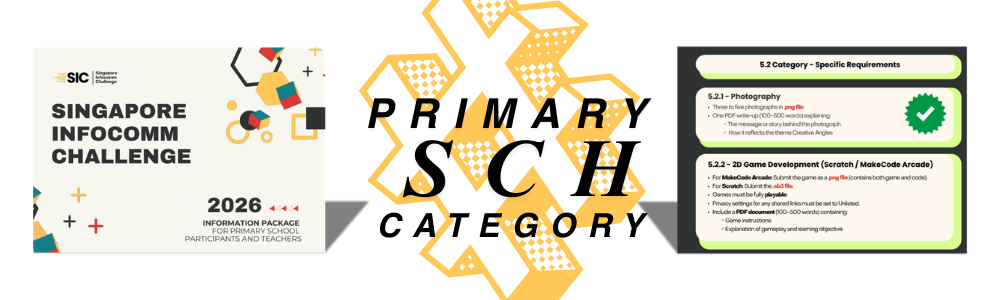
Competition Overview:
The Singapore Infocomm Challenge (SIC) is open to Primary 3 to Primary 6 and Secondary 1 to Secondary 5 students, providing age-appropriate competition categories that encourage creativity, digital innovation, and media literacy.
Primary School Info Pack – Rules & Regulations
1. Competition Overview
The Primary School Category is open to Primary 3 to Primary 6 students and comprises two competition tracks:.
This category is open to Primary 3 to Primary 6 students and features two competition tracks:
- Photography
- 2D Game Development (Scratch / MakeCode Arcade)
Students will work in teams to conceptualise and produce original digital works aligned to the respective competition themes, applying creativity, problem-solving, and foundational digital skills.
2. Eligibility
- Open to Primary 3 to Primary 6 students.
- Students must participate in teams of 2 to 4 members.
- Each team must be supported by a teacher facilitator, who will assist with registration and submission.
- Each student may participate in only ONE category (Photography or 2D Game Development).
- Participation in multiple categories is strictly prohibited.
3. Competition Categories & Themes
3.1 Photography
Theme: Creative Angles
- Students are required to submit three to five original photographs that demonstrates creativity through unique perspectives, viewpoints, or angles.
- Submission Requirements:
- Three to Five photographs per team
- A caption of 100–150 words explaining:
- The idea or message behind the photographs
- How the photographs reflects the theme Creative Angles
3.2 2D Game Development (Scratch / MakeCode Arcade)
Theme: Healthy Living
Students are required to design and develop an original 2D game that promotes healthy living.
- Games must be original student work
- Pre-loaded templates or duplicated projects are not allowed
- The game must include:
- A clear start point
- A clear end point
- Supported platforms:
- Microsoft MakeCode Arcade (https://arcade.makecode.com/)
- Scratch (https://scratch.mit.edu/)
3.2.1 What Is Healthy Living?
Healthy living means building daily habits that help our bodies, minds, and relationships grow strong — now and in the future.
Under Grow Well SG, the Ministry of Health, Ministry of Education, and Ministry of Social and Family Development work together to help children develop healthy habits early, especially in today’s digital age.
3.2.2 Grow Well SG: The 5 Pillars of Healthy Living
Eat Well – Fuel for Growth & Learning
- Eat balanced meals with fruits, vegetables, whole grains, and protein
- Drink water instead of sugary drinks
- Healthy food helps children grow, think clearly, and stay energetic
Sleep Well – Rest for Success
- Get enough sleep every night
- Good sleep improves focus, mood, and physical development
- Less screen time before bedtime = better sleep
Learn Well – Balanced Use of Technology
- Technology should be used purposefully, not excessively
- Too much screen time can affect attention, learning, and emotions
- Children should balance screen time with play, reading, and social activities
Exercise Well – Active Bodies, Active Minds
- Move every day: walk, run, play sports, or dance
- Exercise strengthens the body and boosts confidence
- Being active also improves memory and mood
Bond Well – Strong Relationships Matter
- Spend quality time with family and friends
- Talking, playing, and supporting one another builds emotional well-being
- Strong bonds help children form and maintain healthy habits
- Grow Well SG encourages balanced and meaningful screen use:
- Screens should not replace sleep, exercise, or family time
- Devices should not be used freely without guidance
- Technology should support learning, not distract from it
For more information regarding Healthy Living, visit the Health Hub’s Grow Well page at https://www.healthhub.sg/programmes/parent-hub/grow-well-sg
4. Registration
- Registration Period: Mar 2026 – 31 May 2026
- Schools are required to complete registration online via Eventbrite and make a one-time $5 payment to participate in the competition.
- There is no limit to the number of submissions per school. Only one $5 payment is required per school, regardless of the number of entries submitted.
- Late registrations will not be accepted
- Registration details will be provided via the official SIC channels
5. Submission Guidelines
5.1 General Submission Rules
- Submission Deadline: 31 May 2026, 11:59 PM
- All submissions must be made through the official SIC submission portal.
- Each team is allowed one submission from one category only.
- Duplicate or multiple submissions will result in disqualification.
- Teachers are responsible for submitting entries on behalf of students.
- Submissions must be uploaded via: <Insert Submission Link>
- Entries submitted through other platforms or links will not be considered.
- Any changes made after the deadline will result in disqualification.
5.2 Category-Specific Requirements
5.2.1 Photography
- Three to Five photographs in .PNG or .JPG format
- One PDF write-up (100–500 words) explaining:
- The message or story behind the photographs
- How it reflects the theme Creative Angles
5.2.2 Game Development (Scratch / MakeCode Arcade)
- MakeCode Arcade: Submit the game as a .png file (contains both game and code).
- Scratch: Submit the .sb3 file.
- Games must be fully playable.
- Include a PDF document (100–500 words) containing:
- Game instructions
- Explanation of gameplay and learning objective
- Privacy settings for any shared links must be set to Unlisted.
5.3 File Naming Convention
All files must follow this format:
[SCA]_[SchoolName]_[TeamName]_[ProjectTitle]
Category Abbreviations:
- Photography: PG
- MakeCode Arcade: MCA
- Scratch: SC
Failure to follow the naming convention may result in disqualification.
6. Judging Criteria
6.1 Photography
- Creativity & Originality – 30%
- Visual Quality & Technique – 40%
- Adherence to Theme – 20%
- Presentation & Documentation – 10%
6.2 Game Development
- Creativity & Originality – 30%
- Gameplay & Mechanics – 40%
- Adherence to Theme – 20%
- Presentation & Documentation – 10%
The judges’ decision is final and not subject to appeal.
7. Rules & Conduct
7.1 Intellectual Property
All submissions must be original work created by the students. The submission must represent their own creative and technical efforts
The submitted entries must not have been previously submitted for any other competitions, nor should they have been broadcast or made public through any medium, including but not limited to the Internet, radio, or television
Concurrent submission of the same project for other competitions or to public media is prohibited until the final results of this competition have been announced
Any use of third-party or copyrighted material (e.g., images, soundtracks, video clips) must be appropriately licensed. Teams are required to credit the sources of all media, audio, or external materials used in their projects, including any sound effects or music
The submission of any work that is not original, or any act of plagiarism, will result in the disqualification of the team. Teams are encouraged to thoroughly check all media for proper licensing and permissions
7.2 Code of Conduct
Participants are expected to maintain fairness, respect, and integrity throughout the competition.
Cheating, sabotage, or any form of dishonest behavior will lead to immediate disqualification.
Inappropriate language or behavior during any stage of the competition, including during submission or communication with the organizers, will not be tolerated.
7.3 Technical Issues
The organizing committee will not be held responsible for any technical issues that arise during the project development or submission process, including but not limited to software crashes, hardware failures, or submission portal downtime.
Teams are advised to thoroughly test their projects on different platforms (e.g., Windows, macOS, mobile devices) to ensure compatibility and proper functionality.
Teams experiencing technical issues during submission are advised to notify the organizing team well in advance of the deadline. Late submissions due to technical difficulties will only be accepted with prior notification and valid justification.
8. Rights to Use Submissions
By submitting a project to the competition, participants agree that the organizers may use their submission for promotional, educational, or marketing purposes. This includes the right to display or post winning entries on websites, social media platforms, or other public forums.
Full credit will always be given to the students, teachers, and schools involved in the project. No submission will be altered without the consent of the submitting team.
The organizers will not claim ownership of the submissions, and all copyrights to the work remain with the students. However, by participating, teams grant the organizers a license to use, distribute, and publicly display the entries for the purposes outlined above.
9. Prizes & Recognition
Outstanding entries will be recognised for their creativity, technical execution, originality, and strong alignment with the competition themes. The awards aim to celebrate students’ ability to apply infocomm skills meaningfully while demonstrating innovation, effort, and teamwork.
9.1 Photography
- 1st Prize – Awarded to the team whose photograph demonstrates exceptional creativity, strong visual impact, and outstanding interpretation of the theme.
- 2nd Prize – Awarded for a high-quality submission that shows excellent composition, technique, and storytelling.
- 3rd Prize – Awarded for a well-executed photograph with clear creative intent and effective use of visual techniques.
- 3 Honourable Mentions – Awarded to commendable entries that display strong creativity and thoughtful engagement with the theme.
9.2 Game Development
- 1st Prize – Awarded to the team that delivers an engaging, well-designed game with strong gameplay mechanics and clear alignment to the theme.
- 2nd Prize – Awarded for a game that demonstrates solid programming skills, creativity, and enjoyable player experience.
- 3rd Prize – Awarded for a thoughtfully designed game with clear objectives, functional mechanics, and meaningful theme integration.
- 3 Honourable Mentions – Awarded to teams whose games show creativity, effort, and potential in game design and development.
10. Contact Information
- For any inquiries or technical issues, please contact the competition organizers at support@infocommchallenge.com
© 2026 Singapore Infocomm Challenge 2026. All rights reserved